What's Really in Your Food? Tracing Formaldehyde From Farm to Table
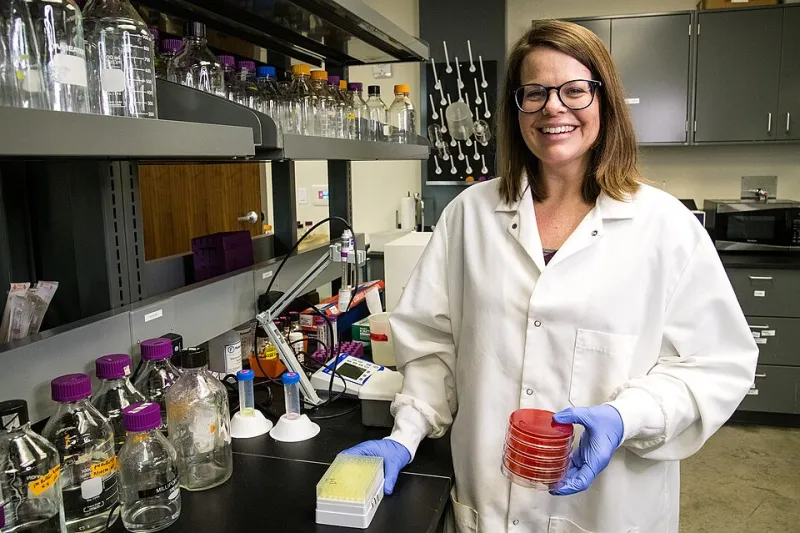
Photo: Ark. Agricultural Experiment Station, CC BY-SA 2.0, via Wikimedia Commons
When most Americans picture formaldehyde, they think of biology class dissection trays or the sharp chemical odor of a new piece of furniture. Few think of their lunch. Yet formaldehyde is present in the food supply through a surprising variety of pathways—some entirely natural, others the byproduct of modern food production. The question worth asking is not simply whether the compound exists in food, but whether current regulatory structures are adequate to protect public health.
A Compound That Occurs Naturally
Formaldehyde (HCHO) is a simple one-carbon aldehyde produced as a normal byproduct of cellular metabolism in plants, animals, and fungi. This means that many whole foods inherently contain trace concentrations of the compound. Shiitake mushrooms, pears, apples, and certain fermented beverages all carry measurable levels. Dried shiitake mushrooms, for instance, have been documented to contain formaldehyde concentrations ranging from roughly 100 to 400 milligrams per kilogram—among the highest naturally occurring levels in any commonly consumed food.
The human body is not unequipped to handle this. Liver enzymes, particularly alcohol dehydrogenase and formaldehyde dehydrogenase, metabolize endogenous formaldehyde rapidly and efficiently. The body itself generates small quantities of the compound through normal one-carbon metabolism. At trace dietary levels, the compound is broken down before it can accumulate to harmful concentrations in tissue.
This biochemical reality is important context for any regulatory discussion. A regulatory framework that treats all formaldehyde exposure as equivalent, regardless of source or concentration, would be both scientifically imprecise and impractical to enforce.
How Formaldehyde Enters Processed Foods
Beyond natural occurrence, formaldehyde can enter the food supply through industrial channels. Packaging is one of the more studied routes. Certain plastics and adhesive resins used in food-contact materials—particularly those derived from formaldehyde-based polymers such as urea-formaldehyde and melamine-formaldehyde—can migrate trace amounts into food, especially when exposed to heat or acidic contents.
The FDA regulates food-contact substances under 21 CFR (Code of Federal Regulations) Part 177, which establishes conditions of safe use for polymers. However, critics note that these regulations were largely developed decades ago, before the proliferation of single-use plastics and before the scientific community had developed the analytical sensitivity to detect low-level migration events with precision. Testing methodologies have improved substantially; the regulatory thresholds have not always kept pace.
Food processing itself can generate formaldehyde as a reaction intermediate. The Maillard reaction—the same browning chemistry responsible for the appealing crust on bread or the sear on a steak—produces a complex cascade of compounds, some of which include reactive aldehydes. Formaldehyde can be produced in small quantities during high-temperature cooking, particularly in carbohydrate-rich foods.
Smoked and cured meats present another avenue. Wood smoke contains aldehydes, including formaldehyde, and some fraction of these compounds is absorbed by food during the smoking process. The FDA does not currently set explicit maximum residue limits for formaldehyde in smoked food products, relying instead on broader good manufacturing practice standards.
The Regulatory Framework—and Its Limits
The FDA's authority over food safety derives primarily from the Federal Food, Drug, and Cosmetic Act. Under this framework, food additives must be approved as safe before use, and substances that migrate from packaging are evaluated as food-contact substances. Formaldehyde is not approved as a direct food additive in the United States. Where it appears, it does so as a naturally occurring compound, a processing artifact, or an indirect contaminant from packaging.
This creates a regulatory gray zone. Because formaldehyde is not intentionally added to most foods, it falls outside the formal pre-market approval process for food additives. The FDA's general safety standard—that a substance must not render a food injurious to health—applies in theory, but enforcement depends on demonstrated harm at actual exposure levels, which is difficult to establish for compounds that appear in minute concentrations.
The contrast with international frameworks is instructive. The European Food Safety Authority has issued more specific guidance on formaldehyde migration from food-contact materials and has evaluated tolerable daily intake levels more explicitly than US agencies have. The World Health Organization's Joint Expert Committee on Food Additives has similarly assessed dietary exposure, generally concluding that typical intake levels do not pose a health risk—but noting that data gaps remain, particularly for vulnerable populations such as infants and individuals with impaired liver function.
Consumer Concerns and Practical Guidance
For consumers seeking to minimize formaldehyde exposure through diet, the science offers some practical direction. Heating food in plastic containers—particularly older or lower-quality plastics—is one area where migration risk is best avoided. Glass and stainless steel containers eliminate this pathway entirely. Reducing consumption of heavily processed or smoked foods is a reasonable precautionary measure, though the evidence that trace formaldehyde in such foods poses meaningful health risk at typical serving sizes is not conclusive.
Whole foods, somewhat paradoxically, can contain higher natural formaldehyde levels than processed alternatives in specific cases. Dried mushrooms are a notable example. This does not mean consumers should avoid them—the health benefits of whole foods are well established—but it does illustrate why simplistic narratives about "natural" versus "chemical" food safety can mislead.
Consumer advocacy organizations have pushed for updated migration testing standards and clearer labeling requirements for food-contact materials. These efforts have gained limited traction at the federal level, in part because the regulatory infrastructure for food-contact substances has historically received less public attention than direct food additives.
Where Gaps Remain—and Why They Matter
The most significant regulatory gap may be in cumulative exposure assessment. Americans are exposed to formaldehyde through diet, indoor air, consumer products, and occupational settings simultaneously. The FDA evaluates dietary exposure; the EPA evaluates air quality; OSHA covers workplace limits. No single agency is charged with integrating these exposure pathways into a unified health assessment.
For the general healthy adult population, this fragmentation may be of limited practical consequence—the body's metabolic capacity to process formaldehyde is substantial. For individuals with chronic liver disease, certain genetic variations in metabolic enzyme activity, or unusually high occupational exposures, cumulative burden becomes a more meaningful concern.
The science of formaldehyde in food is neither cause for alarm nor grounds for complacency. It is, rather, a subject that rewards careful, evidence-based attention—precisely the kind of scrutiny that effective food safety regulation is designed to provide. Whether the current US framework delivers that scrutiny consistently is a question that deserves continued examination.