Zero Is Not an Option: The Engineering Limits of Formaldehyde Exposure Control in Modern Chemical Plants
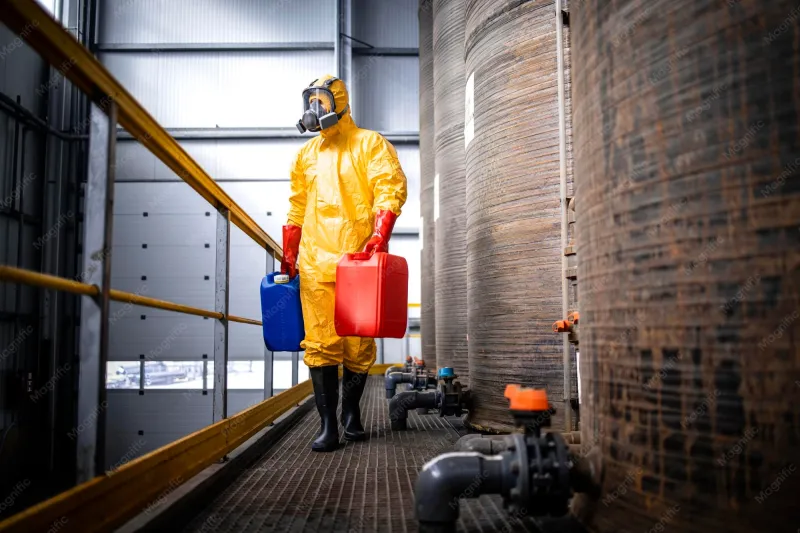
Photo: chemical plant worker industrial safety equipment formaldehyde manufacturing facility, via img.freepik.com
Walk through a state-of-the-art formaldehyde production facility in the Gulf Coast chemical corridor, and the investment in worker safety is immediately apparent. Closed-loop piping systems, continuous air monitoring networks, positive-pressure control rooms, redundant ventilation arrays — the infrastructure is formidable. Yet ask the industrial hygienist responsible for that facility about achieving zero worker exposure, and the answer is almost always the same: it hasn't happened, and there is no credible engineering roadmap that suggests it will.
This is the central paradox confronting the formaldehyde industry in the United States today. The nation's leading producers have poured hundreds of millions of dollars into exposure reduction technology over the past three decades. Facilities routinely meet — and often exceed — OSHA's permissible exposure limit of 0.75 parts per million (ppm) as an eight-hour time-weighted average. And yet measurable exposure persists. The question of why, and what that means for the roughly 2 million American workers who encounter formaldehyde in occupational settings each year, deserves a closer and more technically honest examination than it typically receives.
The Chemistry That Complicates Everything
Formaldehyde's physical properties are a fundamental part of the problem. At room temperature, the compound exists as a gas, and it is extraordinarily efficient at escaping containment. Its small molecular size allows it to permeate seals, gaskets, and valve packing materials that would reliably contain heavier compounds. Its high vapor pressure means that even trace liquid residues on equipment surfaces or inside piping can volatilize rapidly during maintenance operations.
"You can engineer a system that is essentially perfect at steady state," explains one industrial hygienist with more than two decades of experience at large-scale chemical manufacturing sites in Texas and Louisiana. "The problem is that chemical plants are not static environments. You have startups, shutdowns, sampling events, equipment inspections, filter changes. Every time a human being has to physically interact with a process that contains formaldehyde, you are introducing a potential exposure pathway that no amount of passive engineering fully eliminates."
This distinction between steady-state operations and what the industry calls "non-routine tasks" is critical. Modern continuous-emission controls — catalytic oxidizers, wet scrubbers, enclosed transfer systems — are genuinely effective during normal production cycles. The exposure data consistently shows that. But the same data also consistently shows that peak exposures cluster around maintenance windows, equipment turnarounds, and emergency response events. These are precisely the moments when workers are closest to the process and when procedural controls are most difficult to enforce with perfect consistency.
The Limits of Personal Protective Equipment
When engineering controls reach their practical ceiling, the industry turns to personal protective equipment. Supplied-air respirators, full-face cartridge respirators, chemical-resistant gloves, and protective coveralls are standard issue for workers entering high-exposure zones. In theory, properly fitted and correctly used respiratory protection should reduce exposure to near-zero levels. In practice, the picture is more complicated.
Respirator fit is a persistent challenge. OSHA's respiratory protection standard requires annual fit testing, but human physiology changes — weight fluctuations, facial hair growth, and dental work can all compromise the seal of a tight-fitting facepiece between testing cycles. Heat stress in the Gulf Coast's summer climate creates pressure on workers to remove or adjust respiratory protection during extended tasks. And the cognitive and physical demands of complex maintenance work can make strict adherence to donning and doffing procedures genuinely difficult to sustain.
"We do not have a compliance problem in the traditional sense," says a plant safety manager at a major resin production facility who asked not to be identified by name. "Our workers are trained, they understand the hazards, and they take this seriously. What we have is a human factors problem. When someone is troubleshooting an unplanned equipment failure at two in the morning in ninety-five-degree heat, the probability of a perfect PPE protocol is lower than it would be under ideal conditions. That's not an excuse — it's an honest description of the environment we're operating in."
Regulatory Compliance vs. Actual Risk
The gap between regulatory compliance and meaningful exposure reduction is one that industrial hygienists discuss with increasing candor, even if the public conversation around formaldehyde safety rarely reflects this nuance. OSHA's current permissible exposure limit was established in 1992 and has not been revised since. The agency's own action level — the concentration at which enhanced monitoring and medical surveillance are triggered — sits at 0.5 ppm. The National Institute for Occupational Safety and Health (NIOSH) has recommended a much lower ceiling of 0.016 ppm as a carcinogen-based exposure limit, a figure that reflects the compound's classification as a known human carcinogen by the International Agency for Research on Cancer.
The distance between 0.75 ppm and 0.016 ppm is not merely numerical. It represents a meaningful divergence in how regulators and public health scientists assess acceptable risk. A facility can be fully compliant with OSHA standards while operating at exposure levels that NIOSH considers to carry a non-trivial cancer risk over a working lifetime. This regulatory gap places plant managers in an uncomfortable position: they are meeting their legal obligations while simultaneously knowing that some of their workforce may be accumulating exposures that carry long-term health consequences.
Where Technology Is Heading
The industry is not standing still. Several major producers have invested in real-time personal exposure monitoring systems that move beyond the traditional area-monitoring model. Wireless electrochemical sensors worn by individual workers can now transmit continuous exposure data to centralized safety management platforms, allowing supervisors to identify micro-exposure events that would never appear in time-weighted average calculations. This granular data is beginning to reshape how facilities design work procedures, identify high-risk tasks, and prioritize engineering improvements.
Advances in remote and robotic inspection technologies also hold genuine promise. If workers can be removed from the physical proximity of formaldehyde-containing equipment during inspection and sampling activities — replaced by cameras, drones, and automated sampling systems — the non-routine task exposure problem becomes substantially more manageable. Several facilities have piloted drone-based inspection programs for elevated storage tanks and reactor vessels, with encouraging results.
Yet even the most optimistic projections from technology developers stop short of claiming that worker exposure will be eliminated entirely. As long as human beings are required to maintain, repair, and operate chemical infrastructure, some level of contact with the materials those systems contain appears to be an irreducible feature of industrial work.
An Honest Accounting
The formaldehyde industry's safety record has improved dramatically over the past thirty years, and that progress deserves acknowledgment. Exposure-related illness rates have fallen, engineering controls have become more sophisticated, and worker awareness has deepened. But the narrative of continuous improvement should not obscure the structural reality that the safest plants in the country still cannot guarantee zero exposure to a compound that carries a confirmed carcinogenic risk.
For workers, this means that occupational health surveillance — regular medical monitoring, honest communication about cumulative exposure history, and access to informed occupational medicine physicians — remains as important as any hardware investment a facility can make. For regulators, it raises legitimate questions about whether a permissible exposure limit last updated more than three decades ago is adequate for a workforce that will spend entire careers in proximity to this compound. And for the industry itself, it demands a kind of transparency that goes beyond compliance metrics: an honest acknowledgment that regulatory success and the complete protection of worker health are not always the same thing.